


Customer Service Assistance:
900AM - 530PM AEST, Mon - Fri
Call us on 1800 SCOPES (1800 726 737) or
email us

Have you been hearing the terms Cassegrain, Reflector or Refractor thrown around when reading telescope guides? This chapter gives you the low down on the 3 types of telescopes you find in the market and helps you pick one that works best for you!
Firstly, here's a table that gives a general idea of generic specifications of some telescopes and how they relate best to their uses.

Now that you understand some important features of a telescope, let's talk about the three standard types of telescopes:
| Telescope Type | Advantages | Disadvantages | Examples |
Refracting Telescope / Refractor Refracting telescopes are the probably the most common telescope around. They use lenses instead of mirrors and the eyepiece is located at the bottom of the telescope. Their design is similar to binoculars and most spotting scopes. It should be noted that images from refractors are mirror images and can be corrected using an erecting prism. For beginner's this doesn't have a large effect on your viewing experience. |
-Easy to use and consistent due to the simplicity of design. - Excellent for lunar, planetary and binary stargazing especially with larger apertures. - Sealed tube protects optics and reduces image degrading air currents. - Rugged, needs little or no maintenance and its sealed tube protects optics from image degrading. |
- Generally have small apertures, typically 3 to 5 inches. - Smaller apertures mean poorer viewing of distant galaxies and nebulae. - Heavier, longer and bulkier than reflector and cassegrain telescopes of equal aperture. - Good-quality refractors cost more per inch of aperture than any other kind of telescope. |
Celestron AstroMaster 70AZ Refractor Telescope Saxon 90mm Refractor Telescope 909 EQ2 Celestron NexStar 102SLT Computerized Refractor Telescope |
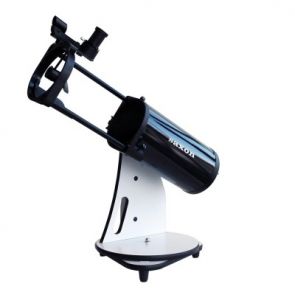
![]() Reflecting Telescope / Reflector Reflecting telescopes use a mirror, instead of a lens, and the eyepiece is located at the side of the main tube. You look through an eyepiece on the side of the tube up near the top. |
- Usually have larger apertures which mean excellent viewing of faint deep sky objects (remote galaxies, nebulae and star clusters). - Low in optical irregularities and deliver very bright images. - A reflector costs the least per inch of aperture compared to refractors and catadioptrics since mirrors can be produced at less cost than lenses. |
- Generally, not suited for terrestrial applications - The tube is open to the air, which means dust on the optics even if the tube is kept under wraps - Reflectors may require a little more care and maintenance |
Saxon F1309EQMS Newtonian Reflector Telescope Celestron Powerseeker 127EQ Reflector Telescope Skywatcher 8” Dobsonian Telescope SW680 |
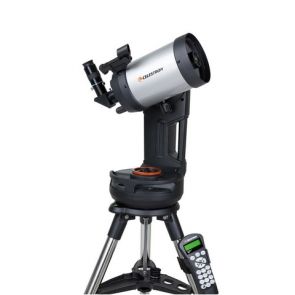
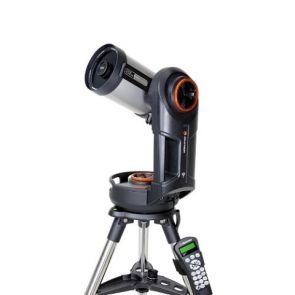
![]() Cassegrain Telescopes / Catadioptric Telescopes use a combination of mirrors and lenses. These telescopes usually have a nice modern design and have and larger apertures. Two of the popular Cassegrain designs are the Schmidt-Cassegrain and Maksutov-Cassegrain. |
- Most versatile type of telescope with excellent lunar, planetary and deep space observing plus terrestrial viewing and photography. - Best near focus capability of any type telescope - First-rate for deep sky observing or astrophotography with fast films or CCD's - Closed tube design reduces image degrading air currents - Compact and durable |
- More expensive than reflectors of equal aperture - Its appearance may not be suited to everybody's taste |
Celestron CGEM-925 Schmidt-Cassegrain Computerized Telescope Saxon M9012EQ Maksutov Cassegrain Telescope Celestron NexStar 8 SE Computerized Cassegrain Telescope |
Apart from the differences in features of the Cassegrain, Reflector and Refractor Telescope, it may also be important to note the sizes of telescopes and once again, consider how you are going to use your telescope. Will you be taking your telescope with you on road trips? You might want to get a Refracting Telescope for its portability. If your telescope will be kept at home and you would like a higher aperture scope to view deep sky objects, a Dobsonian might be a cost-effective, though bulky option.